Budget 2026: A budget that’s pure gold
A disciplined, growth-focused Budget 2026 signals renewed fiscal credibility for South Africa, with meaningful relief for households and a clear commitment to long-term stability.

A disciplined, growth-focused Budget 2026 signals renewed fiscal credibility for South Africa, with meaningful relief for households and a clear commitment to long-term stability.
A stronger starting point
The Finance Minister’s Budget Speech dovetailed neatly with the President’s State of the Nation Address delivered a fortnight ago. It opened with a summary of South Africa’s recent achievements: removal from the FATF grey list, a credit rating upgrade, lower debt-financing costs and a narrowing budget deficit.
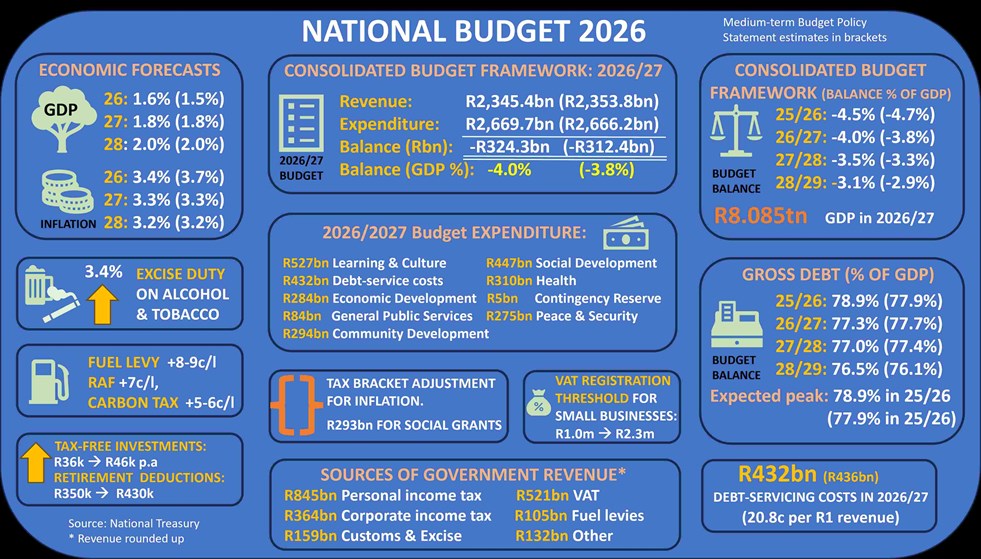
As has been promised for decades, the level of outstanding sovereign debt is expected to peak this year before gradually declining in the years ahead. National Treasury is clearly intent on rebuilding fiscal credibility and this time, it genuinely feels different.
Fiscal discipline and debt stabilisation
A primary budget surplus has now been achieved and is slowly expanding. With an anticipated pickup in economic growth, the debt-to-GDP ratio could begin declining from next year.
While forecasts of a narrowing budget deficit over the medium-term expenditure framework are not new, current tailwinds – including improved revenue collection and disciplined spending – give greater weight to these projections. If maintained, this trajectory could meaningfully reduce the consolidated deficit, ease the debt burden and create more room for growth-inducing expenditure.
That said, it remains concerning that nearly 21 cents of every rand collected by the fiscus is spent servicing debt. The interest bill continues to limit the country’s fiscal flexibility.
Growth: the real cure
Finance Minister Enoch Godongwana allocated additional funding to defence, crime prevention and social upliftment. However, these measures largely address the symptoms rather than the underlying cause of South Africa’s challenges.
The true remedy lies in economic growth. Grow the economy, spread prosperity and crime will decline. Encouragingly, the Minister reinforced this point. Government’s strategy centres on maintaining macroeconomic stability, implementing structural reforms, investing in growth-enhancing infrastructure and building state capacity.
The private sector will play a pivotal role. While progress has been made – particularly in stabilising electricity supply – further reform and investment across broader infrastructure sectors will be essential.
Growth is projected to reach 2.0% by 2028, with inflation expected to moderate to 3.2% in the same year.
Relief for households and investors
A combination of fiscal prudence and a favourable upswing in the commodity cycle enabled the Minister to adjust personal income tax brackets in line with inflation, providing welcome relief to taxpayers. Excise duties on alcohol and tobacco were increased by the inflation rate.
Several other positive measures were introduced:
While the increase in the annual tax-free savings limit was welcome, it was somewhat disappointing that the lifetime limit remains unchanged at R500,000.
Fixing local government and infrastructure
The Minister also announced reforms to municipal infrastructure grants in an effort to address persistent delivery challenges at local government level.
National budgets and plans can be well-structured, but if municipalities fail to allocate revenues appropriately or neglect infrastructure maintenance, service delivery deteriorates. Targeted intervention and improved oversight are therefore critical to ensuring that infrastructure investment translates into tangible improvements on the ground.
Fuel levies and carbon tax
The General Fuel Levy, Road Accident Fund Levy and Carbon Tax on petrol were all increased. However, these adjustments may feel more manageable in the context of recent declines in fuel prices.
A promising start
Overall, there is much for households to appreciate in this year’s budget – particularly given that Treasury was able to withdraw the planned R20 billion in additional tax increases.
The South African Reserve Bank’s disciplined monetary policy has delivered substantial benefits in the form of lower inflation and reduced interest rates. Treasury now appears determined to follow suit through disciplined fiscal policy.
Budget 2026 represents a strong and credible start. The challenge, as always, will be consistent implementation; but the foundations for sustainable growth and improved fiscal health are firmly in place.