Circling to new market highs
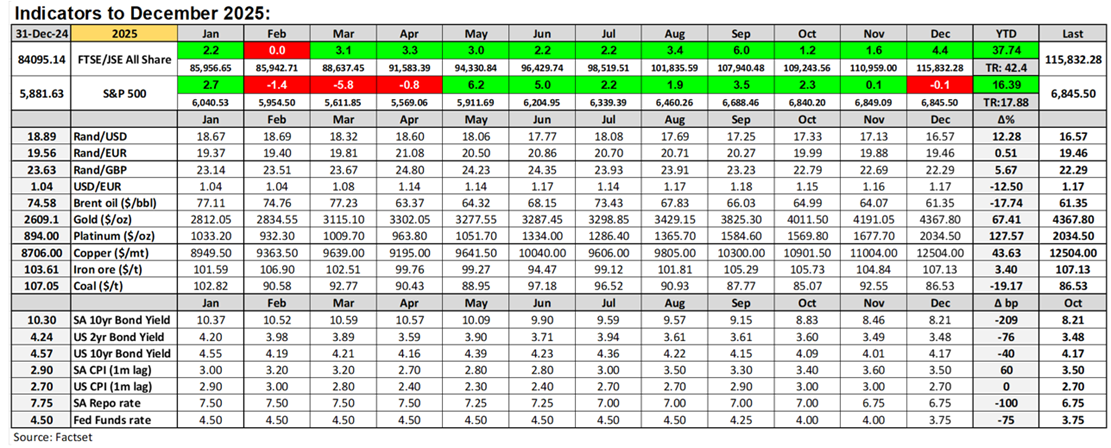
The volatility of November continued into December as hopes for the Federal Reserve Bank’s third rate cut of the year ebbed and flowed. The S&P 500 initially rose to a new all-time high of 6,901 early in the month before slipping back to 6,721 and then rallying again post the Fed’s 25 basis point rate cut to a new record high of 6,932 on Christmas eve (a mini Santa Claus rally). The Fed rate cut was widely anticipated by the time of the 10 December meeting but the accompanying quarterly “Summary of Economic Projections” report or “dot plot” showed a wide dispersion of member opinion on the December meeting outcome as well as on the views of where rates were expected to be over the next two years. The balance of the committee’s opinion was for one rate cut in 2026 but the uncertainty around the strength of the labour market and the magnitude of growth and inflation in the US left conviction around the expectation low. The ongoing criticism by the US president of the Federal Reserve Bank chairman and the pace of the central bank’s policy easing did cast something of a cloud over the market. The uncertainty over who the president might appoint to chair the Federal Reserve Bank once Jerome Powell’s tenure ends in May 2026 added to market jitters. The net result for December was a 0.005% decline in the S&P 500 index and after the November gain of 0.13%, the S&P 500 found itself just five index points higher over the last two months of the year. Nevertheless, the S&P 500 managed a return of 16.39% in 2025 after gaining 23.31% in 2024 and 24.23% in 2023.
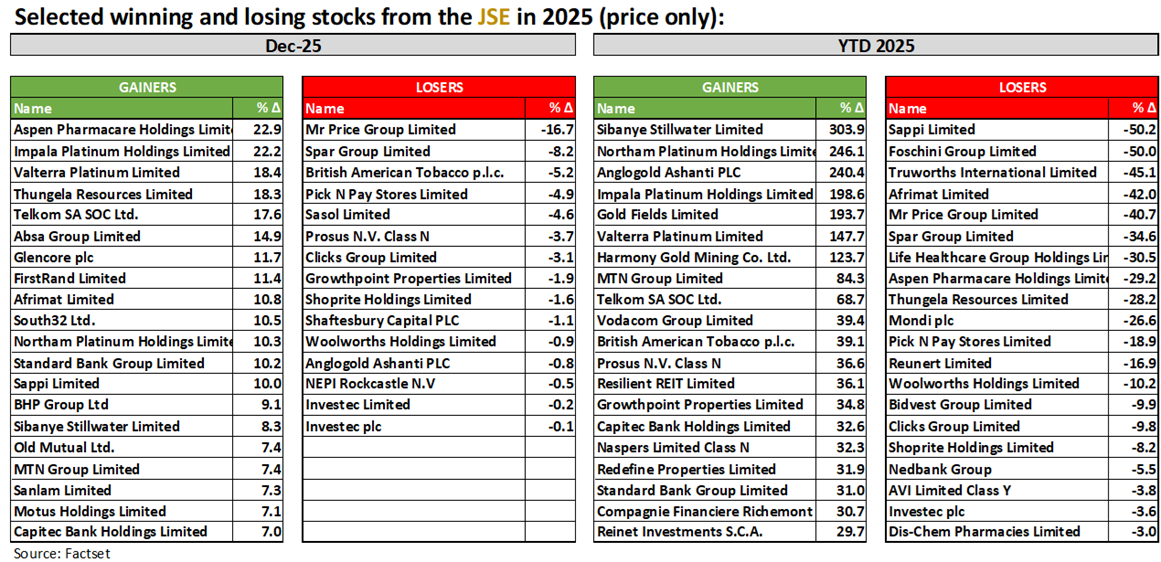
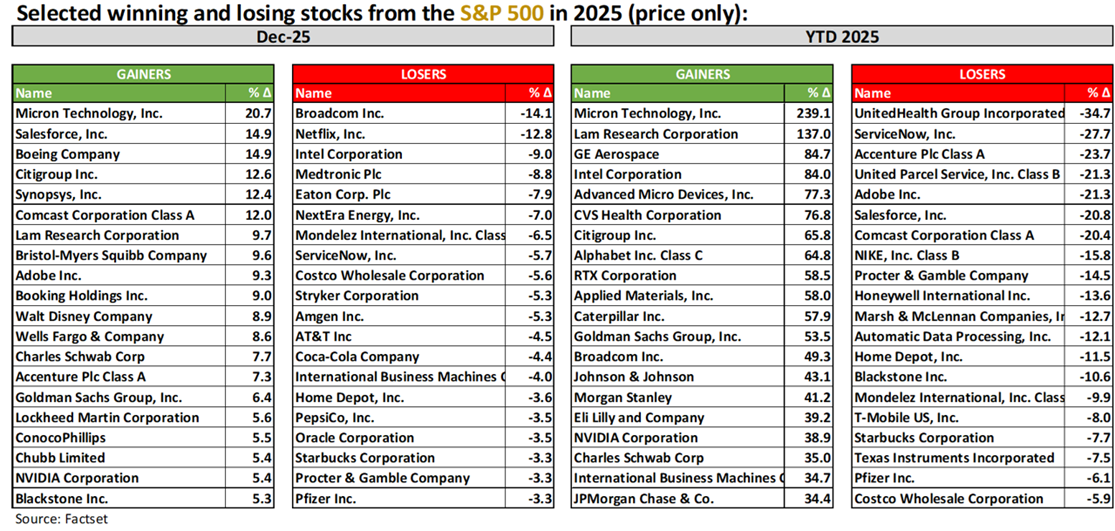
The sectors that outperformed the 0.005% loss of the S&P 500 in December included Financials (+2.9%), Materials (+2.0%), Industrials (+1.1%), Consumer Discretionary (+0.7%) and Energy (+0.1%). The underperforming sectors included Utilities (-5.3%), Real Estate (2-.8%), Consumer Staples (-1.9%), Health Care (-1.5%), Communication Services (-1.0%) and Information Technology (-0.3%). Semiconductor and software company Broadcom (-14.1%) was one of the big losers in the month after reporting strong earnings but guiding to lower margins as hardware becomes a bigger component of its revenue. Netflix (-12.8%) was another big loser after bidding a mammoth $88bn for the streaming, studios and HBO parts of Warner Bros Discovery (“WBD”), which it said it would finance with a significant amount of debt. The much-hyped final season of Stranger Things which aired in December did little to assuage investors’ concerns around the risks of the WBD deal for Netflix. While technology stocks were a little out of favour in December, Micron (+20.7%) was a big winner after providing market-beating earnings and further guiding to strong AI demand for its high-bandwidth and dynamic random access memory chips. Micron topped the gainers list for the year with a price return of 239.1% in 2025. The beleaguered UnitedHealth Group was the deepest in the red of the largest 100 S&P 500 companies, with a share price loss of 34.7% for the year. (See the tables in the appendix below for some of the larger monthly and yearly price movements of stocks drawn from the S&P 500 index and the FTSE/JSE All Share index).
The pot of gold at the end of the JSE’s rainbow
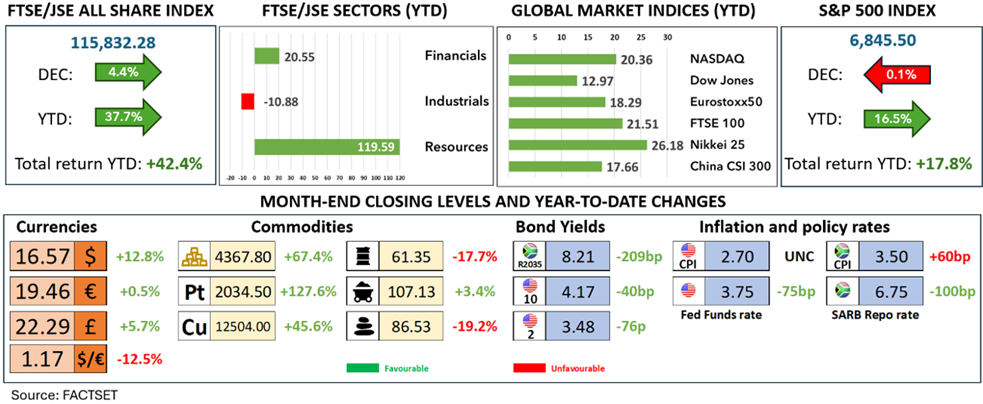
Commodity prices were buoyed again in December as geopolitical concerns ramped up in the month. The Ukraine-Russia war continued unabated, large-scale demonstrations erupted in Iran and the US began seizing Venezuelan oil tankers after its ongoing bombing of alleged Venezuelan drug-carrying vessels. As the US dollar weakened ($1.16/€ à $1.17/€), gold rose 4.5% to a new record level of $4,367.80/0z, platinum grew 6.9% to a record $2,034.50/oz and palladium added 10.9% to close at $1,629.20/oz (after briefly touching $1,984.7/oz late in the month). Impala Platinum (+22.2%), Valterra Platinum (+18.4%) and Thungela Resources (+18.3%) were the big winners on the JSE in the month, only being outdone by the 22.9% gain in Aspen Pharmacare after it announced the R26.5bn cash sale of some of its Asia-Pacific businesses. Despite the late price surge, Aspen Pharmacare still closed 29.2% down for the year. After a number of positive trading updates, the local banks had a bit of a fillip in December. Absa (+14.9%), FirstRand (+11.4%), Standard Bank (+10.2%) and Capitec (+7.0%) all shone brightly. Life Assurers Old Mutual (+7.4%) and Sanlam (+7.3%) also had a positive month and that helped Financials (+7.7%) to pip Resources (+6.3%) in the month. Industrials (+4.5%) also managed to post a rare positive month as the year closed out. It was a one-horse sector race in 2025, however, as Resources (+119.6%) blitzed Financials (+20.6%) and Industrials (-10.9%) languished in the doldrums. Sibanye Stillwater (+303.9%), Northam Platinum (+246.1%), AngloGold Ashanti (+240.4%), Impala Platinum (+198.6%), Gold Fields (+193.7%), Valterra Platinum (+147.7%) and Harmony Gold (+123.7%) all grew their share prices by more than 100% in 2025.
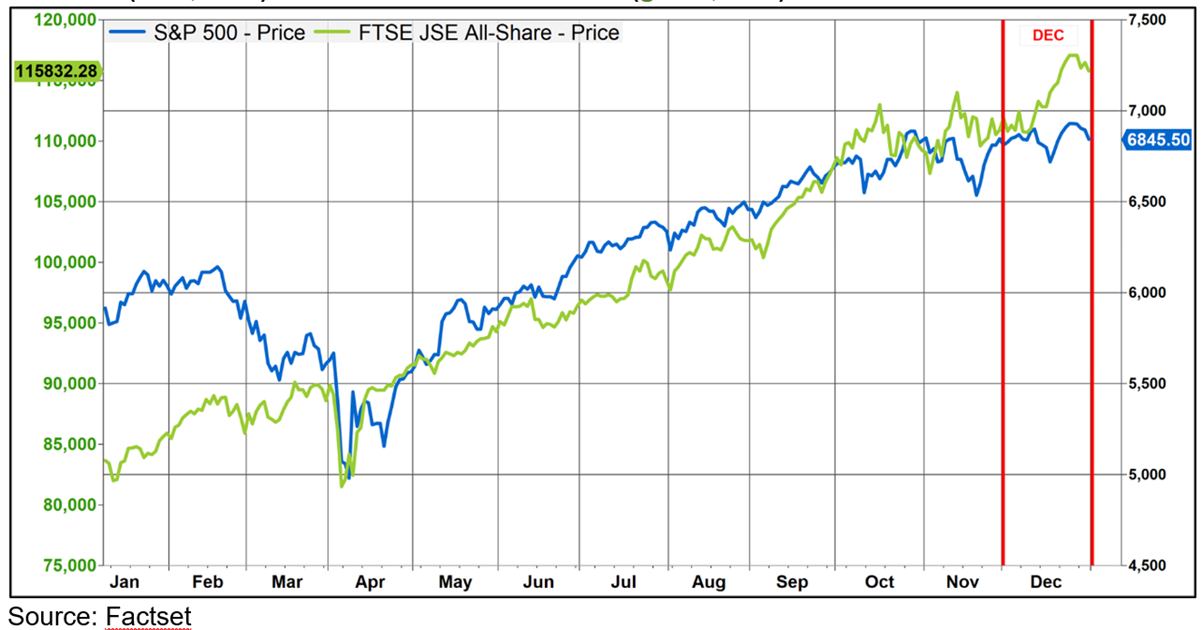
The Mr Price Group (-16.7%) was a big loser in December after it announced the planned €487m acquisition of the NKD Group, a value-style retail chain in Central and Eastern Europe. Overall, retailers had a tough time of it in the year with the Foschini Group (-50.0%), Truworths (-45.1%) and Mr Price (-40.7%) the worst performing of the clothing retailers. Spar (-34.6%), Pick n Pay (-18.9%) and Woolworths (-10.2%) were other retailers that bore the brunt of a very pedestrian South African economy in 2025. Netting out all the share price movements in December, the FTSE/JSE All Share index added 4.4% to lift the index return to 37.7% for the year. The local market recorded 11 positive months in 2025 with the miniscule -0.02% decline in February being the only blot on the JSE’s copybook in the year (see chart and data tables below).
S&P 500 (blue, RHS) & FTSE/JSE All Share Index (green, LHS) – last 12 months
Looking forward to 2026
In the early going in 2026 geopolitical tensions have ramped up, with the US capturing Venezuelan president Nicolás Maduro on his home turf to sit trial in New York on charges of narco-terrorism. The US has captured more Venezuelan oil tankers, bombed Islamic State group targets in Syria and threatened to take over Greenland. Iranian protests have escalated and the US is considering how it might respond – the US has already promised 25% tariffs on any country trading with Iran. The markets have also been spooked by the US Department of Justice’s serving of the Federal Reserve Bank with grand jury subpoenas ahead of a potential criminal indictment. The markets continue to ignore this while earnings growth continues at a steady pace - S&P 500 quarterly earnings have grown for nine consecutive quarters while revenue has grown for 20 consecutive quarters. The table below reflects FACTSET consensus earnings and revenue growth expectations for the S&P 500 companies for the coming quarters.
US fourth quarter earnings are very soon to be reported, with some slowdown in year-on-year growth (8.3%) expected. The outlook for the four quarters of 2026, however, is for double digit growth, with almost 15% earnings growth forecast for the calendar year. At an index level, 15% earnings growth implies a 15% index return should the market valuation remain unchanged. The current forward price/earnings (“P/E”) ratio of the market is 22.2x, which is above the five-year average of 20.0x and the 10-year average of 18.7x. Proponents of mean-reversion theory might say that the market has to devalue from historically expensive levels back to those longer-term averages but that doesn’t necessarily have to happen any time soon, particularly with such solid earnings growth. A P/E of 22x with earnings growth of 15% is not cheap but it is not particularly expensive either. It does imply though, that a significant amount of good news is priced into the market, leaving little room for disappointment. We’ve witnessed before what disappointing earnings or guidance can do to the share price of a highly-prized (and priced) counter. Even if you throw in a little market devaluation, a double-digit return could still be possible from the S&P 500 in 2026 (close to that perennial analyst “10%” annual market growth forecast).

Global equity markets often do exhibit a high degree of correlation but global equity is not a single market. The staggering 37.7% return from the JSE in 2025 was largely a result of the doubling in price of the Resources sector. The Financial sector contributed with healthy growth of 21% but the 11% decline in Industrials added some resistance to the market’s upward trajectory. The financial and industrial counters are broadly (but not solely) dependent on the health of the domestic economy and levels of inflation and interest rates. The local regulatory environment also plays a part as does the currency, which itself is further influenced by domestic politics and South Africa’s perceived standing in the global community. South Africa’s 2025 economic growth rate still needs to be published but expectations for 2026 are for growth of around 1.4%. Rand strength could be maintained for as long as our exporting commodities are so highly-priced and as the US dollar slips modestly weaker. Amidst the current state of geopolitical flux, there does not appear to be a catalyst to push precious metals and key base metals prices lower. High commodity prices should continue to support the local-listed gold and platinum miners and good cash flows and dividends are in prospect. Deficits in some markets, such as platinum and copper, for example, provide additional price support to those counters.
The JSE’s 37.7% gain this year was driven by the 120% gain in Resources (which reflected strong earnings growth) but 2024’s return of 9.4% incorporated an 11% decline in Resources. The local market index grew at a very modest pace of 5.3% in 2023 and shrank by 0.9% in 2022. This series of returns hasn’t left the JSE expensive overall and with consensus earnings growth for 2026 closer to 20%, and with a mid-teens forward P/E below its 10-year average, positive returns from the JSE are expected in 2026. There is no reason to believe that a devaluation of the local market is in prospect and, should earnings grow by 20% as expected, the local market index could provide the same level of growth. The level of the forward P/E may also leave the market a little more forgiving of disappointments, should they arise.
Mood swings: the market’s biggest worry
The positive equity market picture is not without its risks. Global tensions are at an escalated level and there’s no telling what a belligerent, egotistical, maniacal dictator here or there might do. We should also be wary of stratospheric P/E ratios, should they arise, particularly where they are not accompanied by expected future earnings growth of a commensurate magnitude. The performance of individual stocks and individual market sectors will differ from the performance of the market index, as always, but it will be especially important in 2026 to get sector selection and stock selection right.
Appendix: Market Movers