Market and Economic Commentary: January 2026
The party plates from the New Year’s Eve party were hardly washed and packed away when the level of geopolitical craziness in the world was ratcheted up a notch.

The party plates from the New Year’s Eve party were hardly washed and packed away when the level of geopolitical craziness in the world was ratcheted up a notch.

Geopolitics front and centre
The party plates from the New Year’s Eve party were hardly washed and packed away when the level of geopolitical craziness in the world was ratcheted up a notch. The US captured Venezuelan President Nicolás Maduro and his wife from their fortified lodgings in Caracas and captured various Venezuelan oil tankers, effectively taking over Venezuela’s oil industry and its exports. In Iran, civilians took to the streets to protest poor economic conditions and demonstrate against the Islamic Republic government. The violent crackdown on the protestors left thousands dead, with the US responding by sending warships to the region and threatening that “bad things would happen” if Iran didn’t end the violence as well as its nuclear programme. Rhetoric on the US takeover of Greenland by chequebook or force was also ramped up before the US president retracted his hostile tone and talked of having something of a plan with NATO leaders.
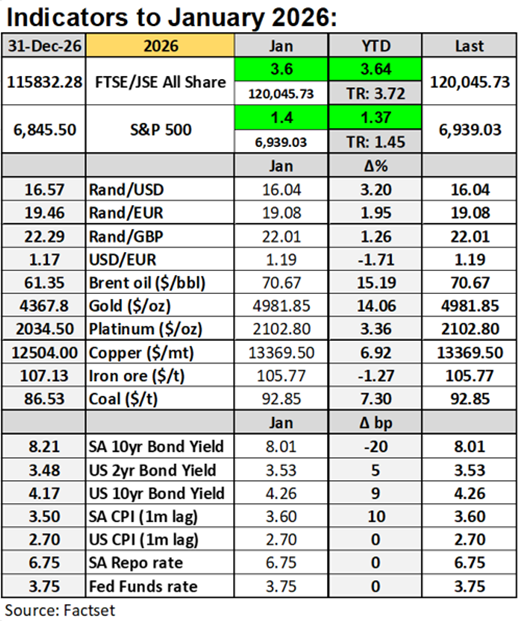
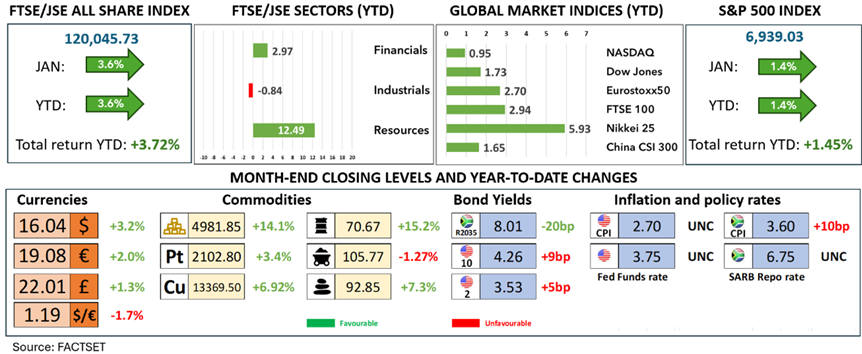
The independence of the US central bank was in the spotlight again in January when papers were served on Federal chair Jerome Powell over building renovation overruns. After that act of hostility, the markets were spooked but investors found a little peace when the US president finally announced that Kevin Warsh, a previous Fed governor, had been given the nod to sit as the next Fed chair when Powell’s term ends in May. Amidst the heightened risk, gold took off, rising from a starting level just below $4,300/oz to a record peak of $5,400/oz on the 29th before closing out the month at $4,981/oz. Silver inexplicably followed the same trajectory rising to $116/oz from a $72/oz start and then closing out the month at $103/oz. Platinum, in turn, started at $2,034/oz, skyrocketed to $2,852/oz and collapsed in a heap to $2,102/oz. As precious metals prices spiked in a moment of risk-off pandemonium, the US dollar weakened to above $1.20/€ (from a start of $1.17/€) before ending January at $1.19/€.
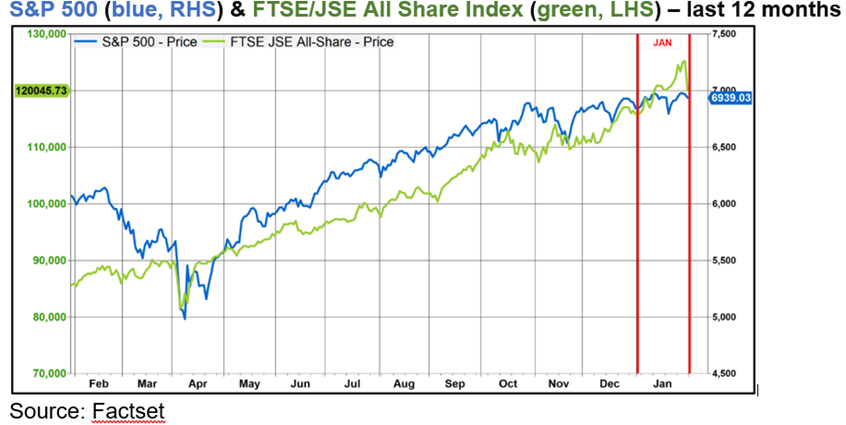
Despite all of the geopolitical volatility, the markets continued on to new highs in January with the S&P 500 index recording a fresh all-time peak at 6,978 points on the 27th and the JSE reaching a record high of 125,249 points on the 29th (see graph below). The South African market did, however, collapse on the last day of the month (-4.15%) but still closed up 3.6% for January. The S&P 500 slid around 0.6% lower over the three days following its peak but still managed to close out the month 1.4% higher. The sectors that outperformed the 1.4% gain of the S&P 500 in January included Energy (+14.4%), Materials (+8.6%), Consumer Staples (+7.5%), Industrials (+6.6%), Communication Services (+5.7%), and Consumer Discretionary (+1.7%). The underperforming sectors included Utilities (+1.32%), Technology (-1.7%) and Financials (-2.61%). On the JSE, the 2025 story of the sectors continued, with Resources climbing 12.5%, Financials gaining 3.0% and Industrials losing almost a percent. While central banks around the world have largely been on a path of easing monetary policy through the lowering of interest rates, the Federal Reserve Bank left its target for the Fed Funds rate unchanged at 3.75% in the last week of January while the South African Reserve Bank’s Monetary Policy Committee left the Repo rate unchanged at 6.75%.
Artificial Intelligence: Friend or market foe?
Markets have been concerned over the huge amount of capital that the “hyperscalers” have been investing into AI infrastructure and have been questioning when those investments will ultimately provide a commensurate return. Meta, Amazon, Microsoft, Alphabet, Tesla and Oracle have led the charge in spending hundreds of billions of dollars on data centres, semiconductors, memory chips, networking, energy and cooling systems and other infrastructure for the AI ecosystem. Chinese technology behemoths like Alibaba, Tencent and Baidu have also been spending a significant amount in capital expenditure so as not to be left behind in the AI race.
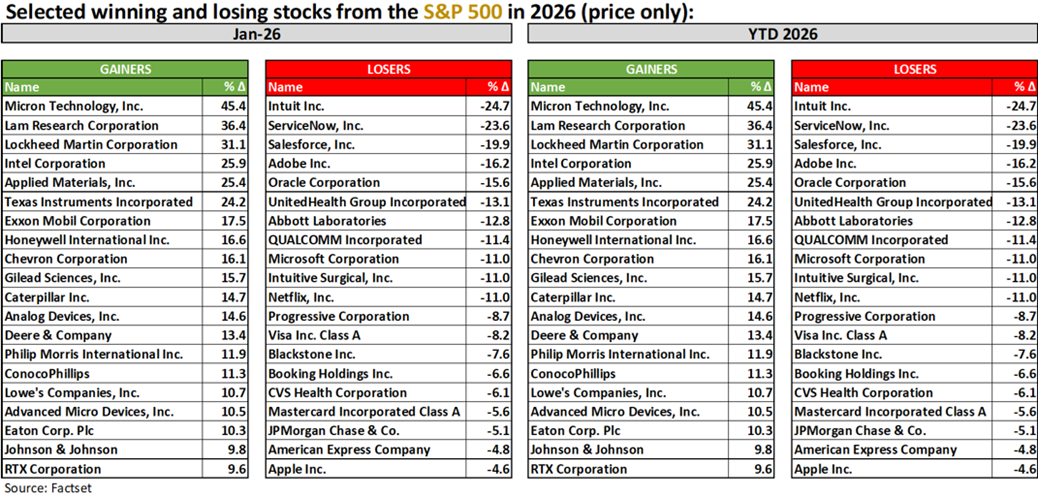
High Bandwidth Memory (“HBM”) Chips are the latest part of the AI supply chain to come under pressure from overwhelming demand and that has accelerated the share prices of the suppliers. Micron Technology is one of a handful of key suppliers of HBM chips globally and the share price gained 45% in January after rising 239% in 2025. Lam Research (+36%), Intel (+26%), Applied Materials (+25%), Texas Instruments (+24%), Analog Devices (+14%) and Advanced Micro Devices (+11%), all key providers of products and services in the semiconductor industry, also had an exceptionally strong start to the year as the AI wave continued on relentlessly. With the surge in AI offerings and the coding capabilities of that AI, the market has very quickly decided that pure software companies are under threat. Who needs an expensive team of software engineers and coders if AI can code applications in the blink of an eye? It’s inevitable that there will be some casualties along the way but it does look like more of a knee-jerk reaction from the market and that should provide for cheaper entry points into quality software names when the dust settles. QuickBooks owner Intuit (-25%), ServiceNow (-24%), Salesforce (-20%) and Adobe (-16%), all providers of niche software offerings, topped the losers list in January.
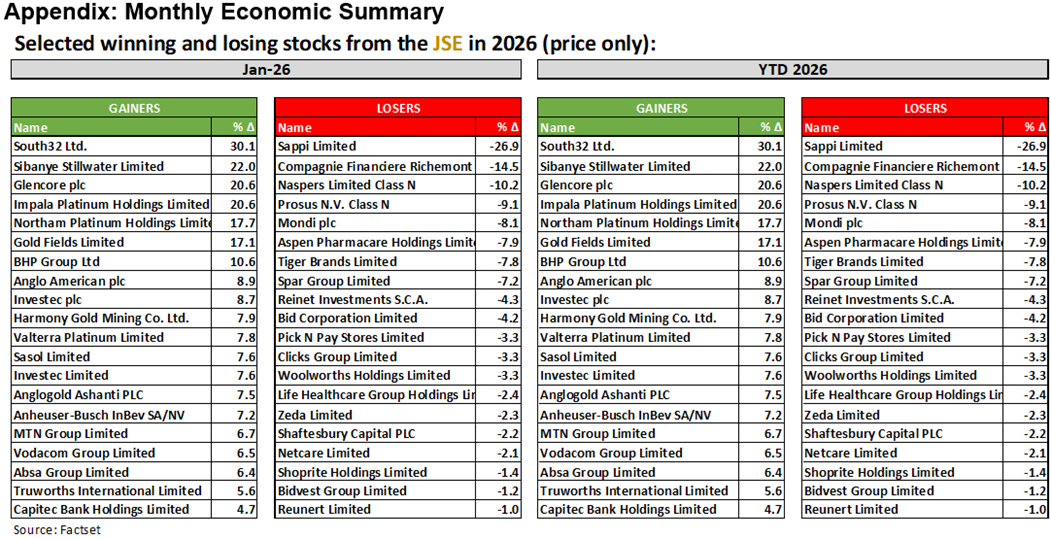
Trading on the JSE in January followed the same pattern of trading that we witnessed throughout 2025. Resources and Basic Materials stocks accelerated, Financials ambled along and Industrials slipped modestly backwards. Nine of the top 10 performers in the month came from the Basic Materials sector with South32 (+30%), Sibanye Stillwater (+22%), Glencore (+21%), Implats (+21%), Northam (+18%) and Gold Fields (+17%) leading the way. Sappi (-27%) was by far the worst performer amongst the larger capitalisation stocks on the back of lower dissolving wood pulp prices, pressure on sales volumes and a much stronger rand. Richemont (-15%) posted good Q3 sales numbers in the month but after an initial share price jump on the day, the market became less enamoured with the numbers and priced Richemont lower. The luxury goods company grew revenue in all regions but perhaps not to the extent that the market was expecting. A large comparative sales base and wildly fluctuating exchange rates did act as a headwind to growth rates in the third quarter. The cash position did decline modestly from €7.9bn to €7.6bn but it’s difficult to believe that investors interpreted that as a big negative. Naspers (-10%) and Prosus (-9%) were also under the cosh in January. The companies’ primary investment, Chinese-listed Tencent, had a volatile month on concerns around a higher VAT rate on its offerings but that came to nought (for now) and investors were more likely concerned about a potentially slower pace of share buybacks to support prices.
Earnings, growth and valuations
Valuations are critical. The old adage goes that “great companies may not necessarily make great investments”. That’s because we expect great companies to continuously do great things and positively surprise us all the time. We value them highly because we know that they are reliable and that they will continually grow their earnings. The problem arises when “everyone” wants a piece of the action and they buy the company’s stock with no concern for the price that they are paying. Demand for the shares drives up the price to the point where what you are paying for the shares is often not reflective of the worth of the company. This can happen when investors sell off their shares to below what they are intrinsically worth too. Of course there are other adages like, “a share is only worth what someone is prepared to pay for it” and Buffet’s/Graham’s, “price is what you pay, value is what you get”. Expressions abound in the markets but it does seem more intuitive that if you buy something when it is expensively priced, your risk of loss is higher than when if you buy it at a cheaper price or a discount to its intrinsic worth. Cheap and expensive and value are subjective terms and shares can stay at expensive or cheap levels for long periods of time. Cheap companies sometimes go bust because they’re cheap for a reason. Market frenzy or momentum can keep share prices moving in a single direction for some time too and that can make expensive shares even more expensive or cheap shares even cheaper. Investors need to do their homework around price and value and they have to be prepared to be patient – that’s difficult in this always on and always available world where we demand instant gratification.
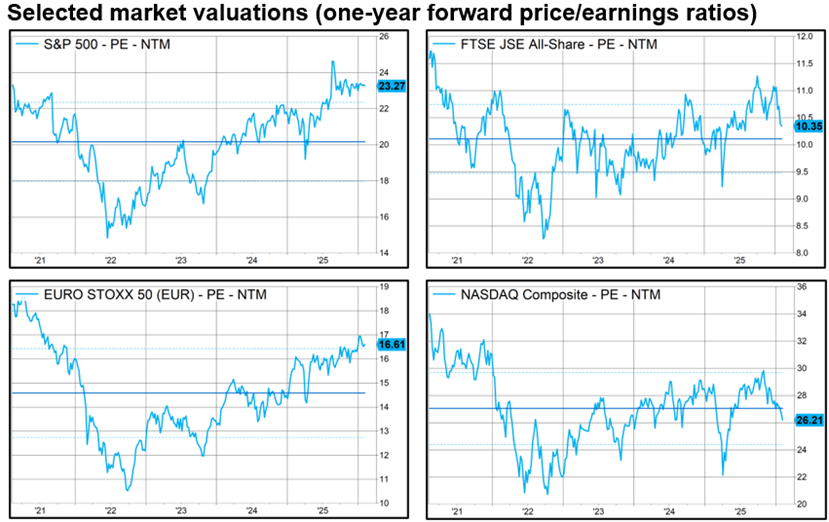
The graphs below reflect the valuation (forward price/earnings ratio) of a number of markets over the past five years (including a horizontal average line and a one standard deviation line on either side). The valuations of the S&P 500 and the Euro Stoxx 50 indices are at historically expensive levels while those of the JSE and the NASDAQ are closer to neutral or fair value. As highlighted last month, high valuation levels can be sustained and more easily justified while the underlying companies are delivering the commensurate growth in earnings. Expectations for earnings growth from the S&P 500 companies continue to be marked higher as actual results are released (see the table below) and this looks positive for further gains in the US market this year. Market indices can also be distorted by a handful of shares and that must also be taken into any investment consideration. The S&P 500, for example, has a very big weighting to the “Magnificent Seven” companies and those stocks have driven earnings growth substantially higher. On the JSE, the precious metals stocks have had a massive influence on the valuation and performance of the overall market over the past year. For this reason, it’s critical to examine one’s sector selection and stock selection extremely carefully, and always to exercise patience and never to overpay!