Not such a month of love
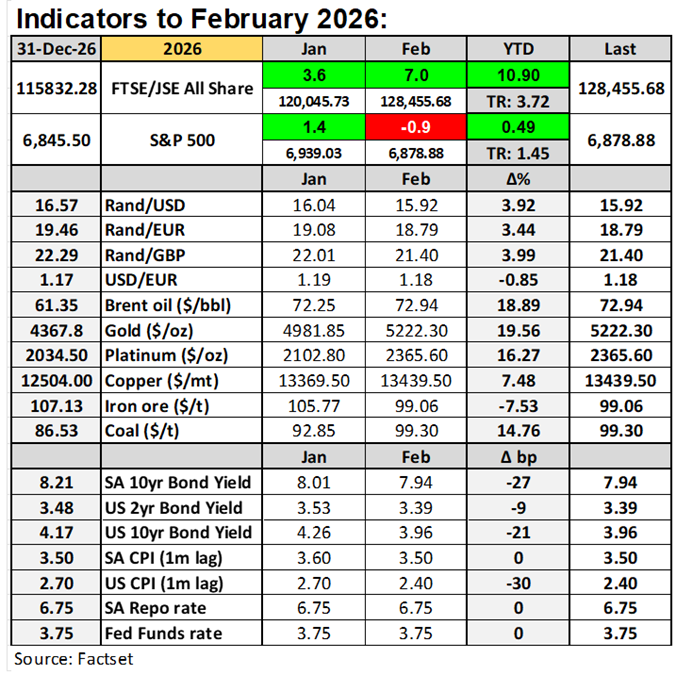
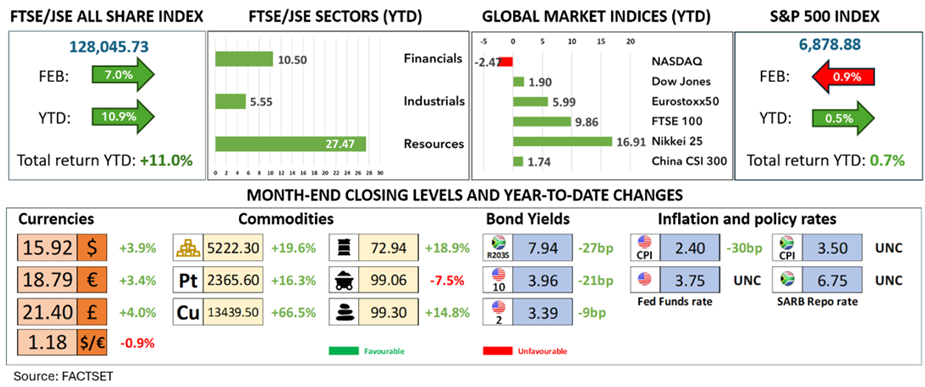
The first US strikes on Iran took place on the last day of February as the markets paused for the weekend. Futures prices immediately dipped lower and investors began seeking out the classic safe-havens of gold and the US dollar. Geopolitical tensions had been rising over the final fortnight of February as the US handed Iran an ultimatum to disband its nuclear programme completely and eradicate its ballistic missiles or “bad things would happen”. Gold and platinum prices increased by 5% and 13% respectively over the course of February as nerves were getting rattled while Brent crude oil prices remained largely unchanged at around $72-$73/bbl. Post the initial US and Israeli strikes on Iran and that country’s counterstrikes on various sites in the Middle East, the oil price spiked. Brent crude moved closer to $80/bbl on concerns of lower oil supplies from Iran and also from Iran’s closure of the critical Strait of Hormuz shipping channel.
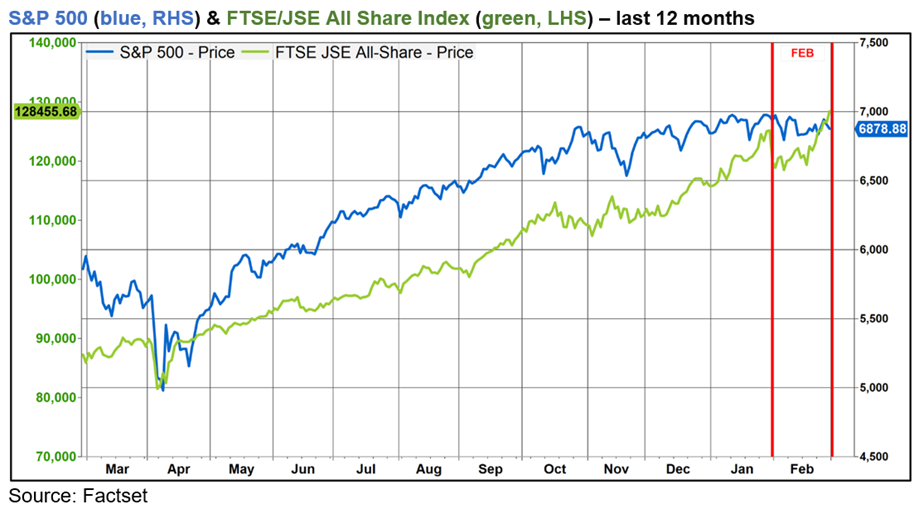
The higher precious metals prices had a markedly positive impact on the JSE, with the Resources sector jumping 13.3% in February for a year-to-date (“YTD”) gain of 27.5%. AngloGold Ashanti led the way higher with a 30% gain in the month (+40% YTD) while Sasol added 27% to be up 37% for the year. Valterra (+23%) was the best performing platinum miner in the month and closed out February only fractionally behind Implats’ 35% YTD gain. The Financial sector gained 7.3% in the month to be up 10.5% YTD while Industrials gained 6.4% for a positive return of 5.6% for the year so far. Aspen Pharmacare, which lost 29% last year, gained 26% in February, but its month-end closing price of R135.41 is still a long way from the R250 price recorded in July 2024 and the R440 price of January 2015. The Spar Group (-21%) lost ground after announcing the departure of its CEO Angelo Shwartz and then following that announcement up with poor earnings results. Pick n Pay (-19%) also had a torrid month after posting an improved year-on-year interim result but one which still amounted to a headline loss of R439m (previously -R803m). With all of the JSE’s market sectors up in the month, the FTSE/JSE All Share index gained a total of 7.0% to reach a new all-time record close and to be up 10.9% for the year so far. Over the past year, the JSE has provided a capital return of 49.5% with a total return (including dividends) of 54.5% (see the green line in the chart below).
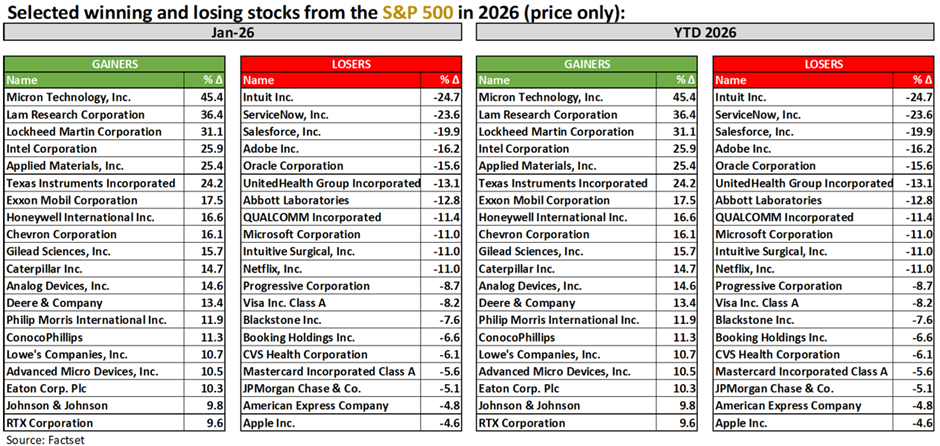
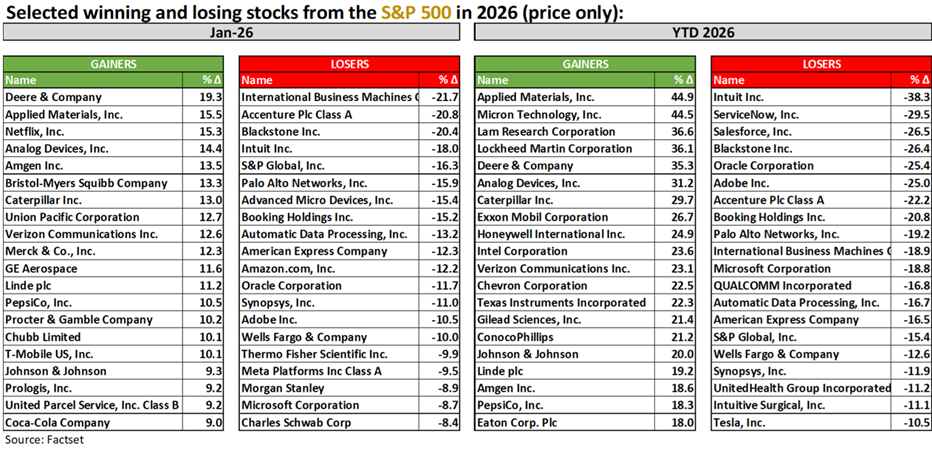
The S&P 500 lost ground in February, declining by 0.87%, to be up just 0.5% for the year (a total return of 0.7%). Over the past 12 months, the benchmark index has gained 15.5% for a total return of 17.0% (see the blue line in the market chart below). Sector rotation was the name of the game in February as investors continued to trade out of mega-capitalisation technology shares and into cyclical counters. The sectors that outperformed the 0.87% decline in the S&P 500 index in February included Utilities (+9.87%), Energy (+8.77%), Materials (+8.27%), Consumer Staples (+7.87%), Industrials (+6.97%), Real Estate (+6.23%) and Healthcare (+3.42%). The underperforming sectors included Consumer Discretionary (-5.42%), Communication Services (-5.14%), Technology (-3.98%) and Financials (-3.83%). The lower Technology sector mirrored the performance of the Nasdaq Composite Index which declined by 3.38% in the month to reflect the ongoing concerns around the disruptive impact of Artificial Intelligence (“AI”) on software companies. QuickBooks owner Intuit (-38%), business workflow enterprise ServiceNow (-30%), customer relations management software-provider Salesforce (-27%) and Photoshop owner Adobe (-26%) were all amongst the biggest losers of the large capitalisation S&P 500 stocks. Nvidia shot the lights out when it released its much-anticipated earnings results, with revenue $2bn ahead of expectations and guidance almost $6bn ahead of expectations. Even with good future earnings growth still in prospect, the share sold off and closed the month down 7.3%. Alphabet similarly posted strong results but finished down 7.8%, while the $200bn of planned capital expenditure by Amazon (-12.3%) scared investors, despite a strong result from Amazon Web Services. The funding of AI capital expenditure and the private credit market has also come under intense investor scrutiny. Blackstone (-20%) was another big loser in the month (-26% YTD), following a record redemption by investors in its flagship private credit fund.
The big winners after two months of 2026 have been the companies associated with providing materials and memory to the semiconductor production process. Applied Materials (+45%), Micron Technology (45%), Lam Research (37%) and Analog Devices (31%) have been amongst the biggest gainers this year. (See the appendix for a table of the winners and losers on the JSE and the S&P 500 in February and for the year-to-date).
S&P 500 (blue, RHS) & FTSE/JSE All Share Index (green, LHS) – last 12 months
Market Outlook
During peacetime, the US market takes its direction from the economic indicators that provide clues as to the direction of interest rates. Labour market, growth and inflation indicators that point to softer interest rates are welcomed by the market but higher inflation, strong growth data prints and a tight labour market are considered to be more hawkish indicators that are more concerning for market watchers. Global investors also watch these indicators keenly, as strong US markets usually set the tone for the rest of the world. All bets are off for now, following the start of the war on Iran. The biggest concern is around the potential impact of higher oil prices on inflation – and hence interest rates. A quick war with limited damage to oil supply would help get the market back on track but a protracted war with sustained higher oil prices would drive inflation higher, end hopes of another two rate cuts in the US this year and set the market back. The US president has indicated the potential for the war to continue for four weeks or more but no-one can say how long or how far the war will actually go. Markets are more prone to sliding backwards during periods of uncertainty and so we could be in for a period of volatility while the war plays out. The US Supreme Court’s ruling against Trump’s unilaterally imposed tariffs and all of the Epstein files drama will be consigned to the latter pages of newspapers while the war rages on. During that time, the best market indicator to watch will be the oil price. During times of market uncertainty, it’s important not to panic and make rash investment decisions. Rather, as the UK’s World War II posters implored, “Stay Calm and Carry On”.
Appendix: Monthly Economic Summary